
Legal Limits of Digital Surveillance and Phone Searches: The Conflict Between Judicial Practices and Constitutional and International Safeguards (An Empirical Study)
Intrudction
In recent years, Egypt’s public sphere has witnessed a growing reliance on the digital sphere as a primary space for opinion-expression, political debate, organisation, and mobilisation, particularly as traditional physical spaces have receded
In response to this notable shift, the authorities have developed a multi-layered regulatory and surveillance system that employs digital monitoring as a mechanism for tracking opinion and expression activities across cyberspace.
In practice, this has led to a systematic expansion in the prosecution of opponents, activists, and ordinary citizens, alongside the normalisation of custodial penalties imposed on the basis of their digital expression.
Within this framework, the Ministry of the Interior does not operate as an isolated actor; rather, it functions as the executive arm and the final procedural link in an integrated legislative and institutional apparatus deliberately designed to manage and censor the digital sphere.
The mechanisms of this system, along with their historical and philosophical underpinnings, can be understood through three primary dimensions. The first explains the structural nature of surveillance, in that it reconfigures cyberspace as the ideal prison structure,one that places the user under the gaze of a constant, anonymous monitoring eye[1]. Within this framework, the surveillance role is not confined to vertical (top-down) oversight by sovereign state bodies; rather, it extends to generate a pattern of horizontal or reciprocal surveillance among users themselves. In this context, individuals engage in mutual social monitoring, with a particular focus on tracking intellectual and political orientations, as well as activists and opponents. This frequently evolves into digital mobilisation and pressure campaigns aimed at prompting the authorities to intervene and pursue the targeted individuals through judicial channels.
This behaviour coincides with the overlap and integration of competencies among the institutional bodies entrusted with digital surveillance roles. The surveillance function extends beyond security agencies to encompass several entities, most notably the Supreme Council for Media Regulation(SCM) , which exercises broad regulatory and punitive powers over digital accounts and platforms, and the Monitoring and Analysis Unit affiliated with the Public Prosecution, which proactively tracks online content under the pretext of protecting public values. Moreover, this multi-layered surveillance network generates a state of perpetual anxiety among activists and ordinary users, which voluntarily culminates in the imposition of self-censorship on their expression within the digital sphere.
The second dimension pertains to the legal legitimation of this multi-layered surveillance system. This is embodied in the language employed by laws concerned with regulating the digital space, combating cybercrime, and countering terrorism, legislation that abounds with vague and open-ended phrases, typically linked to considerations such as ‘the protection of national security.’ In practice, such formulations permit the circumvention of constitutional guarantees relating to freedom of opinion and expression, or their effective neutralisation, while simultaneously bestowing an aura of legality upon the judicial prosecution of opponents.[2]
As for the third dimension, it represents the historical roots of this institutional surveillance model. Modern history reveals a persistent tendency, dating back to the nineteenth century, on the part of modern state apparatuses to exercise censorship and control over human activities and the public sphere. The current digital surveillance regime constitutes an extension of this long-standing institutional legacy.[3]
The digital surveillance system materialises through multiple procedural forms, including the continuous tracking of activists’ personal accounts, daily monitoring of their digital activity, scrutiny of political hashtags, keyword filtering, surveillance of closed groups, and the aggregation of publicly available data concerning users’ intellectual orientations. These practices are grounded in a domestic legislative framework that grants surveillance authorities broad discretionary powers. This framework extends from the Telecommunications Regulation Law No. 10 of 2003-specifically Article (64) pertaining to technical support for security agencies[4], to the Law No. 175 of 2018 on Combating Cyber and Information Crimes, particularly Articles (25) and (27) concerning offences against societal values and the misuse of the internet[5], provisions that have been repeatedly invoked in the judicial prosecution of digital publications. It also encompasses the Anti-Terrorism Law No. 94 of 2015, notably Article (29), which criminalises the creation, management, or use of any website on communication networks or the internet for the purpose of promoting terrorist ideologies or misleading the authorities,a provision that is consistently employed in practice as a legal framework for prosecuting dissenting digital content.[6]
These legislative instruments intersect with Law No. 96 of 1952 Regulating Expert Testimony Before Judicial Authorities. This law governs judicial reliance on technical expert reports that transcribe and examine digital evidence collected through surveillance. Investigative bodies and courts accord these technical reports near-absolute evidentiary weight. In practice, this practice strips digital expression of its technical and political context, transforming online speech into raw criminal material (actus reus).[7]
A sharp legal contradiction defines the core research problem. Systematic law enforcement practices collide directly with constitutional and international guarantees protecting freedom of opinion, expression, and creativity.
This tension appears most clearly in the functional transformation of judicial police officers . Instead of investigating material crimes after commission based on reasonable suspicion, officers now function as proactive censors. They inspect personal accounts and randomly search mobile phones in public spaces. These practices directly violate Articles (57), (65), (67), and (71) of the Egyptian Constitution[8], which safeguard privacy, telecommunications confidentiality, and the freedom of expression, publication, and artistic creation.
These practices also violate binding international legal standards. Article (17) of the International Covenant on Civil and Political Rights (ICCPR) prohibits arbitrary or unlawful interference with privacy and correspondence. Article (19) of the ICCPR guarantees the right to seek, receive, and impart information and ideas through any media, regardless of frontiers.[9]
The surveillance apparatus goes beyond tracking digital content. It integrates directly with physical and procedural coercion through two primary mechanisms.
First, security forces execute random, compulsory searches of mobile phones at street checkpoints and public squares. The mobile phone transforms from a private communication tool into a permanent checkpoint. Officers exploit street stops to search private messages and personal accounts without judicial search warrants or a state of flagrante delicto (in act).
Second, the state codifies remote pretrial detention renewals through virtual litigation sessions. This system isolates defendants from direct physical contact with judges and legal counsel. Virtual hearings reflect the overarching logic of digital surveillance: they reduce the physical presence of detainees to video screens. This strips fair trial guarantees and defense rights of substantive meaning, enabling the routine extension of pretrial detention based solely on digital monitoring reports.
This report addresses key research questions:
First, how did the state assemble the legislative arsenal underpinning digital surveillance? The analysis examines the multiplicity of institutional actors monitoring virtual space, alongside the routine acceptance of technical reports lacking substantive forensic scrutiny.
Second, the second chapter demonstrates how these statutory instruments redefine the functional role of judicial police officers under the Egyptian Code of Criminal Procedure. It examines the field practice of compulsory mobile phone searches during random stops, detailing how courts render digital evidence derived from these forced searches legally admissible.
Finally, the report analyzes active criminal cases against activists, researchers, and creators prosecuted for exercising their rights to expression, research, and legitimate criticism. It documents how these statutory frameworks enable the systematic tracking of public sources and the weaponization of digital evidence in criminal prosecutions.
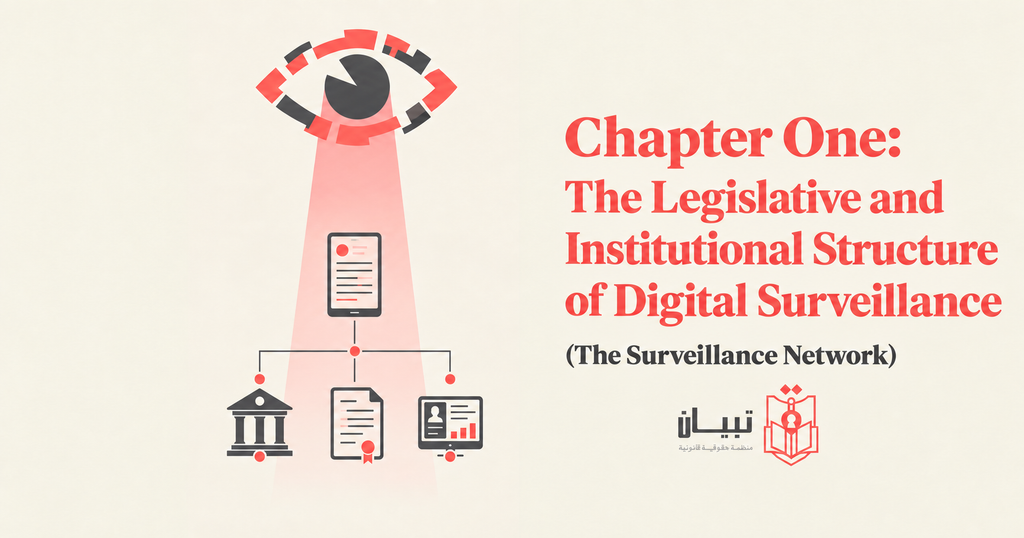
Chapter One: The Legislative and Institutional Structure of Digital Surveillance (The Surveillance Network)
The Multiplicity of Entities Responsible for Digital Surveillance and Institutional Overlap
The Ministry of Interior-alongside its investigative and technical apparatuses-does not operate as an isolated actor enforcing surveillance and control over Egyptian cyberspace. Instead, it functions as the final procedural and executive link in a multi-agency institutional network. Within this network, state entities divide roles and merge competencies to exert comprehensive control over the public digital sphere, systematically narrowing the space for political expression[10].
This structural overlap goes far beyond preliminary inquiries or gathering evidence under the Code of Criminal Procedure. It establishes successive layers of digital tracking that originate in administrative bodies and culminate in criminal prosecution and physical arrest.
The Supreme Council for Media Regulation (SCM), established under Law No. 180 of 2018, serves as a primary pillar in this digital control system. The law grants the Council broad regulatory powers where administrative oversight directly intersects with punitive judicial enforcement. Under Article (19) of the Press and Media Law, these powers enable the Council to monitor digital content, issue website blocking orders, and subject personal social media accounts, blogs, and pages with over 5,000 followers to continuous state surveillance.[11]
Through these statutory powers, the SCM operates as the first tier of digital content filtering. In practice, the Council identifies dissenting political and economic opinions and recharacterizes them as acts warranting criminal prosecution.
This dynamic is evident in the Council’s targeted blocking of independent digital media platforms. On 13 October 2023, the SCM issued a formal decision to block Mada Masr. Conversely, authorities blocked Al-Manassa arbitrarily [12], without publishing any official administrative order.[13]
Furthermore, this procedural intersection between administrative regulation and criminal enforcement appeared when the Council summoned the editorial team of Sahih Masr. The Council issued a formal warning and demanded the removal of investigative reports detailing local economic crises, relying on vague administrative allegations of “publishing false news that harms state institutions.”[14]
The procedural repercussions of these administrative actions extend far beyond regulatory penalties or fines. In practice, security agencies within the Ministry of Interior transform SCMadministrative decisions into reference documents and evidentiary baselines when drafting preliminary police reports and initiating criminal investigations against journalists and platform owners. Administrative surveillance directly serves as the legal justification for criminal prosecution.
Administrative oversight intersects with proactive judicial surveillance, structurally formalized through Public Prosecution Resolution No. 565 of 2020[15], which established the Monitoring and Analysis Unit . This unit conducts continuous daily scans of social media platforms, tracking viral hashtags and trending content.
Operating independently of traditional criminal complaints regarding specific material offenses, the Unit exercises autonomous digital surveillance under elastic statutory concepts such as “protecting Egyptian family values,” preserving public morals, and preventing public order disturbances.
The Public Prosecution’s official statement regarding the “TikTok girls” cases-specifically those of Haneen Hossam and Mawada Al-Adham-provides a clear case study of this system in practice. The official statement explicitly noted that criminal proceedings did not originate from a victim’s police report. Instead, the Monitoring and Analysis Unit flagged circulating video clips that it deemed violations of societal values.
Based on this autonomous judicial tracking, the Prosecution issued formal directives to the General Administration for Information Technology (the Internet Police),the specialized digital crime unit within the Ministry of Interior. The Prosecution instructed officers to conduct field investigations, identify the digital and physical identities of the creators, and execute arrest warrants.[16]
This operational model represents a structural shift in criminal procedure. Judicial monitoring by the Prosecution now precedes and directs police field work, crystallizing the elements of a criminal case before any physical arrest occurs on the ground.
The digital control network expands beyond vertical (top-down) state surveillance to activate horizontal or reciprocal surveillance among users. Systematic monitoring by state entities incentivizes private individuals and organized groups to monitor their peers, tracking political, intellectual, and artistic opinions expressed online.
These practices frequently escalate into coordinated online pressure campaigns designed to force state intervention. This dynamic has fueled a cadre of specialized lawyers who file mass criminal complaints backed by screenshots harvested from the accounts of activists, critics, and ordinary citizens.
For example, these actors initiated intensive legal campaigns against poet and writer Ahmed Douma following his published critique of prison expansion, alongside similar actions targeting satirical content creators on charges of “insulting state institutions.”
Security agencies then use these citizen complaints as procedural cover to execute arrests, framing state intervention as a necessary response to public demand and social order. This integration of institutional surveillance and horizontal societal pressure fosters widespread precautionary fear, forcing creators and users into strict self-censorship.
This institutional convergence,combining SCM administrative surveillance, Public Prosecution proactive tracking, and horizontal societal reporting-establishes a regime that transcends traditional state functions. The Ministry of Interior acts as the final procedural execution arm, converting digital monitoring outputs into physical detentions against citizens, activists, and opponents.
By departing from traditional police work based on investigating material crimes after commission, the Egyptian state has reconstituted its institutional apparatus into a permanent censor of the public digital sphere.
The Legislative Basis and the Utilisation of Technical Examination Reports:
This institutional and societal surveillance regime relies on a sweeping legislative framework that confers procedural legitimacy upon state control. Through a series of specialized statutes, the Egyptian state has codified digital surveillance, providing a cover of legal authorization for prosecuting individuals who exercise their fundamental rights to freedom of opinion and expression online.
This legal framework begins at the structural level of communications networks. Article (64) of the Telecommunications Regulation Law No. 10 of 2003 obligates all telecommunication network operators and internet service providers to furnish, at their own expense, the technical capabilities, equipment, software, and systems required by national security apparatuses to control communication lines and extract digital data[17]. By compelling private technology providers to build backdoors for state intelligence and law enforcement, this provision establishes the infrastructure for mass surveillance. It converts private entities into legally bound technical partners, enabling security agencies to compile databases and track information flows without seeking prior, individualized judicial authorization for every monitoring operation.
Beyond network-level access, statutes governing Egyptian cyberspace deploy elastic, poorly defined language to criminalize peaceful digital expression. The Law No. 175 of 2018 on Combating Cyber and Information Crimes, commonly known as the Cybercrime Law, serves as the primary instrument for targeting activists, political opponents, and content creators. Article (25) criminalizes any act that violates family values or principles in Egyptian society. Lacking any statutory definition, this elastic concept gives prosecutors broad discretion to target personal opinions, satirical commentary, and critiques of state policy. Complementing this provision, Article (27) penalizes anyone who creates, manages, or uses an online account to commit a crime punishable by law. Security agencies routinely stack Article (27) charges alongside Article (25) violations, multiplying legal penalties for a single act of digital expression.[18]
Authorities frequently combine these cybercrime provisions with Article (29) of the Anti-Terrorism Law No. 94 of 2015. Article (29) imposes severe prison sentences on anyone who establishes or uses a website to promote ideas calling for terrorist acts, mislead security authorities, or influence the course of justice. Though framed as a counter-terrorism measure against armed groups, prosecutors regularly apply Article (29) to peaceful political speech, recharacterizing critical commentary as acts that indirectly cause a disturbance of public peace and order.[19]
To secure convictions, state institutions must convert digital tracking outputs into solid criminal evidence admissible before investigative authorities and courts. However, a significant gap exists between statutory technical safeguards and courtroom practice under Decree-Law No. 96 of 1952 regulating expert testimony before judicial authorities.[20]
Digital evidence, such as social media posts, private messages, and video files, is inherently fluid, volatile, and susceptible to tampering, fabrication, or deletion. Recognizing these vulnerabilities, Law No. 175 of 2018 and its executive regulations mandate strict chain-of-custody protocols for digital evidence to retain legal admissibility. These requirements include ensuring data integrity, maintaining continuous digital documentation, verifying data provenance, and employing technical preservation methods that safeguard the file’s digital fingerprint or hash value.[21]
In practice, investigative authorities and courts routinely bypass these statutory safeguards. The Public Prosecution relies almost exclusively on technical examination reports generated by state-aligned personnel, specifically the Internet Investigations Department within the Ministry of Interior or Ministry of Communications experts. These experts examine seized devices, transcribe digital content, and confirm IP address links. Egyptian criminal courts accord these official technical reports near-absolute evidentiary weight, treating them as unassailable material facts rather than technical opinions subject to challenge under the doctrine of judicial discretion in evaluating evidence.
This judicial approach conflates proving the technical existence of data with proving criminal liability. The technical expert merely establishes a material link between digital content and a hardware device or IP address[22]. Current court evaluations fail to address critical legal defenses, such as establishing the defendant’s effective physical control over the device at the time of publication, or excluding alternative hypotheses such as account hacking, unauthorized third-party access, or content alteration via synthetic media and digital manipulation. Furthermore, forensic experts are qualified to analyze technical data, not determine whether a publication constitutes a protected exercise of free expression or a criminal offense.[23]
By giving digital evidence quasi-conclusive absolute evidentiary weight, courts strip digital content of its objective contexts. Judicial proceedings treat digital logs as definitive physical evidence, akin to illegal weapons or narcotics, while disregarding defense arguments regarding the lack of criminal intent (mens rea), procedural nullity during technical search and seizure, or network-level data corruption.
The operational fusion of vague statutes and unchecked forensic reporting fundamentally transforms the legal characterization of online speech. Courts routinely reclassify protected expression into grave state-security offenses, such as joining a terrorist group, furthering the objectives of a terrorist organization, or broadcasting false news to disrupt public order.
Despite the deferential weight courts assign to official forensic reports, these technical findings remain legally contestable before trial judges. Because electronic evidence must satisfy statutory chain-of-custody standards under Law No. 175 of 2018, defense counsel can challenge its admissibility by identifying procedural gaps, establishing failure to preserve the digital fingerprint, or demonstrating potential third-party tampering.
Chapter Two: Field Practices of Digital Surveillance and the Problematique of Judicial Policing
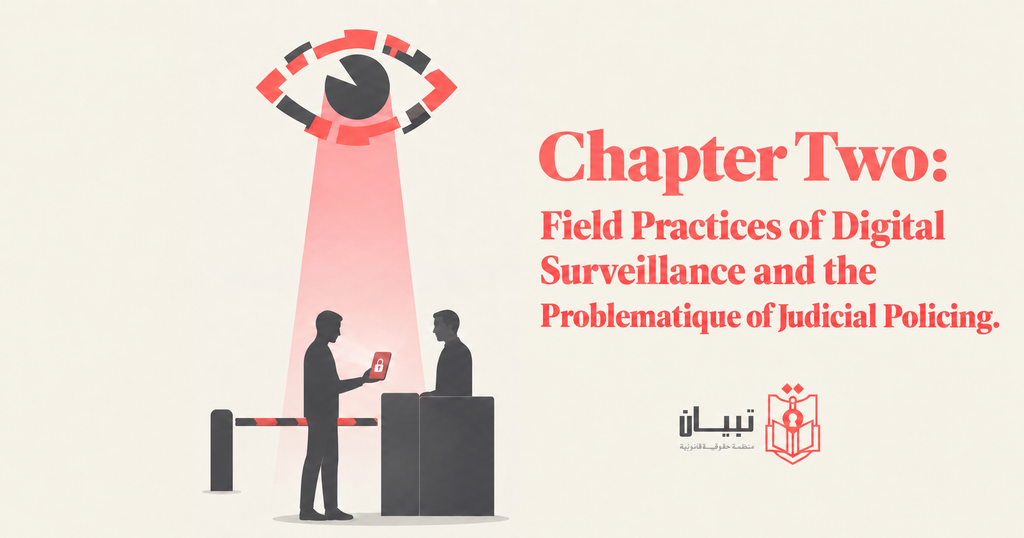
The criminal procedural system relies on protecting personal liberty and the privacy of individual communications. These intrinsic constitutional guarantees allow state intrusion only within the narrowest bounds and under strict controls prescribed by law. Yet, police operations have shifted drastically. Surveillance has moved from monitoring the public digital sphere to targeting personal devices in public spaces through random stops and searches of smartphones and laptops.
This pattern of policing undermines fundamental legal protections. It creates serious defects regarding the legitimacy of seized evidence, the invalidity of searches initiated without cause , and the fabrication of false states of flagrante delicto ( in act).
Arbitrary Stops and Field Searching of Smartphones
Police tactics at security checkpoints, traffic stops, and public squares follow a routine pattern. Officers randomly stop citizens, order them to hand over their devices, and inspect their personal social media accounts, messaging apps, photos, and chat logs[24]. In practice, officers use these searches to sweep for signs of political activity or critical expression. Security forces execute these actions under the framework of administrative or security “stopping” . Officers justify the measure as a precautionary step to detect crime, verify identity, or screen for political suspicion near key public spaces.
The detention of screenwriter and director Moamen Hassan near Tahrir Square illustrates this pattern. Officers randomly stopped Hassan, pulled him from a taxi, and physically searched his mobile phone without a warrant. The officer accessed a private Messenger conversation containing passing political commentary. Authorities then held Hassan unlawfully before referring him to the Public Prosecution in Case No. 662 of 2021 (Qasr El-Nil Misdemeanors). He was charged under anti-terrorism and cybercrime laws with using a website to promote a terrorist act.[25]
Legally, these practices violate the statutory definition of a legal stop established by the Egyptian Court of Cassation. Under the law, an officer may only stop a person who voluntarily places themselves in a clear position of suspicion that warrants identity verification[26]. Mere presence in a public space or on public transit is not a crime. The law presumes citizens are innocent and free.
Demanding to inspect a smartphone exceeds the limits of an administrative stop, which is strictly restricted to checking personal identity or enforcing traffic rules. Forcefully inspecting a device turns a routine stop into a full search conducted without a warrant or a valid state of flagrante delicto (in act).[27]
A smartphone is no longer just a phone. It is a digital repository holding a citizen’s private life, correspondence, financial records, and personal thoughts. Accessing these applications without procedural authority directly violates Article 57 of the Egyptian Constitution[28], which guarantees the privacy of postal, telegraphic, and electronic communications. The constitution prohibits monitoring or inspecting communications without a reasoned judicial warrant for a specified duration. Checkpoint searches executed through intimidation or by exploiting a citizen’s ignorance of the law are procedurally void.
Digital Flagrante Delicto and Nullity of Derived Evidence
To cover the lack of a judicial warrant during field stops, police routinely legitimize searches in their official arrest records by claiming they caught the suspect in flagrante delicto (in act) . An officer typically writes that he suspected the citizen politically during a stop, searched the device, and discovered a post inciting against the state, spreading false news, or containing a criminal conversation. Officers cite Article 30 of the Code of Criminal Procedure (Law No. 150 of 1950), which restricts flagrante delicto ( in act) to crimes perceived directly and concurrently through the senses shortly after commission.[29]
This procedural excuse fails basic rules of criminal evidence. Legal doctrine and Court of Cassation precedent establish that flagrante delicto ( in act) attaches to the crime itself, not to the person. An officer must discover the crime purely by chance through direct perception (such as sight or hearing) before making an arrest or starting a search.[30]
Smartphones are locked with passwords or biometrics. An officer cannot view a private post or chat without first seizing the phone and searching it. This creates a fatal legal fallacy: the unlawful search created the state of flagrante delicto, rather than a valid state of flagrante delicto justifying the search.
Under the established principle of the Court of Cassation, “that which is built on nullity is itself null and void.”
This illegal characterization invalidates all subsequent legal proceedings. It also conflicts with statutory data protections. Article 57 of the Constitution explicitly protects private life and digital correspondence. Reflecting these principles, the Personal Data Protection Law (Law No. 151 of 2020) forces all entities to maintain strict security standards and prohibits viewing, processing, or disclosing personal digital data without explicit prior consent.[31]
Arbitrary phone searches at checkpoints directly violate Law No. 151 of 2020. They strip personal devices of their constitutional protection as virtual extensions of the home. This defect invalidates the arrest report, the Internet Police forensic examination, and the arresting officer’s testimony. Courts cannot rely on evidence obtained by violating constitutional rights, requiring trial judges to throw out the evidence and acquit the defendants.[32]
Case Study: Ahmed Douma
(Legitimizing Legal Prosecution of Written Opinion Through Proactive Monitoring of Open Digital Sources)
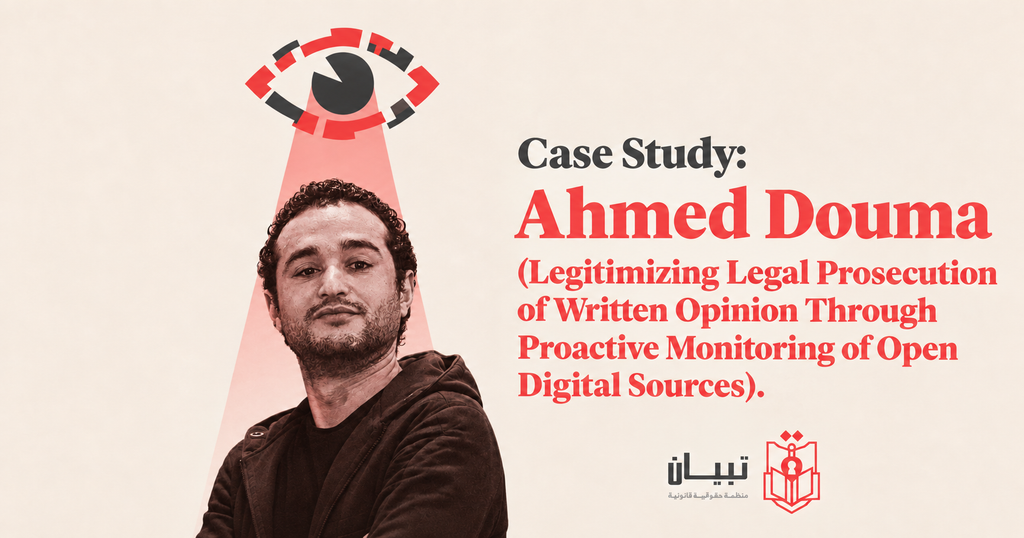
Case No. 2449 of 2026 (Supreme State Security Prosecution), registered as Case No. 4894 of 2026 (Fifth Settlement Misdemeanors), against writer and activist Ahmed Saad Douma, demonstrates how proactive digital surveillance works in practice. The case shows how security agency tracking tools merge with coordinated citizen complaints to build legal justifications for prosecuting written opinions.[33]
Facts, Chronology, and the Weaponization of Complaints
The prosecution began with journalistic writing. On March 25, 2026, Douma published an opinion piece on ”Al-Araby Al-Jadeed” titled “From the Prison Inside the State to the State Inside the Prison.” The article analyzed and criticized the expansion of new prison facilities as tools of social control. Douma later shared links to the article on Substack and Facebook.
Case records reveal how state surveillance relies on peer-to-peer reporting. The case did not start with an immediate physical arrest. Instead, on March 30, 2026, a wave of near-identical complaints was filed across multiple police stations in different governorates, including Al-Mansheya, Al-Dekheila, Al-Sharabiya, Al-Zawiya, Al-Ameriya First, and Sharbin. The complaints used matching legal language, claiming the complainants read the article on Facebook and that it contained false news inciting against state institutions.[34]
This unnatural timing and matching phrasing show that these complaints were coordinated. They provided police with a procedural excuse to intervene under the guise of responding to public reports. This allowed state agencies to hide their proactive digital tracking behind citizen complaints, avoiding procedural invalidity.
Using these complaints as cover, the investigating officer drafted a report on April 1, 2026, reframing an opinion article as a criminal offense. The officer claimed Douma “persistently broadcasts false news and rumors to incite against state institutions” to “instigate citizens to gather, commit violence, and bring down the state.”
Legal Errors and Nullification of Constitutional Protections
This process reveals major structural flaws in the evidence and procedures used:
Criminalizing Expression and Manufacturing Harm:Authorities ignored Douma’s status as a journalist exercising rights guaranteed under Articles 65 and 71 of the Constitution. Instead, the Public Prosecution charged him under Articles 80(D) and 102 (Bis) of the Penal Code with “deliberately broadcasting false news and rumors abroad to weaken state prestige and instill terror.”
Prosecutors inferred criminal intent (mens rea) using subjective interpretations of Douma’s metaphors. The investigating officer claimed the article caused “citizens to feel fear and unease,” without presenting any real evidence that public alarm occurred. This turns the right to criticize state policy into criminal evidence based entirely on security interpretations.
Over-reliance on Screenshots: Law No. 175 of 2018 on Combating Cyber and Information Technology crimes requires strict rules for digital evidence, including a documented digital chain of custody and server verification. However, the Internet Police technical report (dated 26 April 2026) consisted entirely of screenshots of the Facebook and Substack posts attached as physical evidence.[35]
Screenshots do not prove effective physical control over an account at the time of publication. The report failed to trace IP addresses, inspect device digital fingerprints, or rule out account hacking. Prosecutors relied entirely on superficial visual evidence to jail the defendant, ignoring defense objections regarding the invalidity of the screenshots and Douma’s lack of control over the publishing platforms.
Flawed Judicial Reasoning:The court relied on horizontal ( Lateral)surveillance to convict Douma. Instead of addressing the weak technical evidence, the court combined the coordinated citizen complaints with the police investigation to establish guilt. This violates Cassation Court precedent, which requires criminal convictions to rest on certainty rather than suspicion, and holds that police investigations are merely personal opinions that cannot serve as the sole basis for a conviction.
Conclusion of the case study :
The Ahmed Douma case shows how state surveillance operates as an integrated system. Police run proactive digital surveillance, use coordinated citizen complaints as a legal cover to act, and rely on sub-standard technical evidence like simple screenshots in official forensic reports. This system routinely yields criminal convictions that violate constitutional guarantees protecting press freedom and digital expression.
Second Case Study: Ashraf Omar
(Criminalization of Digital Visual Expression, Institutionalization of Technical Isolation Mechanisms, and the Expansion of Terrorism Financing Offenses)

Case No. 1568 of 2024 (Supreme State Security Prosecution), referred to trial as Case No. 11846 of 2025 (Fifth Settlement Felonies, registered under No. 2240 of 2025, New Cairo Misdemeanors), concerning translator and cartoonist Ashraf Omar, exemplifies the expanding scope of state digital surveillance. It demonstrates a clear instance where digital monitoring resulted in the legal prosecution of visual expression and satirical art.
The research significance of this case lies in documenting a procedural shift: moving beyond the mere reliance on digital evidence to the digitalization of the judicial procedure itself through virtual litigation techniques. Furthermore, the case witnessed an unprecedented expansion of the concept of “terrorism financing” to encompass the dissemination of data and information across cyberspace.
Proactive Digital Surveillance and the Stripping of Visual Art from Its Context
The criminal prosecution relied on tracking the defendant’s digital footprint across independent online publishing platforms, where he worked as a cartoonist and translator for the news website Al-Manassa. Police authorities actively monitored his published artwork across digital platforms, specifically targeting satirical cartoons that addressed pressing socio-economic issues like the national energy crisis, scheduled power outages, and sovereign debt.
The structural defect in this approach lies in how the security apparatus interprets visual content. Digital monitoring mechanisms fail to process visual metaphors within their creative or figurative context. Instead, security agencies flatten the artistic medium, transforming it into rigid material evidence subject directly to the Penal Code and Law No. 175 of 2018 on Combating Cyber and Information Crimes .
This became more pronounced when investigative authorities moved beyond inspecting publicly available content. They extended their technical examination to the defendant’s personal computer and local digital storage, extracting saved drafts and unreleased artistic sketches. Prosecutors then recharacterized these private files as “preparatory criminal plans and execution-ready projects.”[36]
This procedural approach conflicts directly with Article 67 of the Egyptian Constitution, which explicitly prohibits filing lawsuits to suspend or confiscate artistic, literary, or intellectual works, or against their creators, except through the Public Prosecution. Article 67 forbids custodial penalties for offenses relating to the publication or expression of artistic products.
However, the presence of digital publishing tools allowed investigative authorities to bypass this constitutional immunity. Prosecutors activated the provisions of Law No. 175 of 2018, invoking charges such as “misuse of telecommunications networks” and “broadcasting false news via information networks.” As artistic work transitions from physical canvas to digital screen, this practice strips constitutional protections of their intended substance.
The Abrupt Indictment and the Expansion of “Digital Financing”
The climax of these procedural shifts arrived with the indictment for criminal trial in November 2025 (in Case No. 11846 of 2025, Fifth Settlement Felonies). The indictment revealed a new legal formulation of charges within the context of joining Omar with 12 co-defendants, levying far graver charges under the Counter-Terrorism Law.
The most critical charge in the indictment is the “commission of a financing crime, funding with money, data, and information for the benefit of a terrorist group.” Incorporating “data and information” as a material element (actus reus) in terrorism financing represents a severe practical expansion of state surveillance mechanisms.
The procedural flaw in this reasoning becomes evident through three main dimensions:
Conflating Expression with In-Kind Financing: Framing the charge in this manner demonstrates that investigating authorities treated caricatures, digital files, and intellectual ideas (whether published or stored in the defendant’s computer) as intangible assets or informational support falling under the criminalization of financing. Such an interpretation blurs the boundary between opinion offenses (for which the Constitution prohibits custodial sentences) and material terrorism financing. Practically, this enables the prosecution of digital content creators on felony charges carrying life imprisonment simply for circulating data that diverges from security narratives.
Absence of Digital Forensic Evidence: Levying a charge of terrorism financing via digital media strictly requires a technical report issued by specialized Cyber Forensics. This report must prove the existence of digital flows, cryptocurrency transfers, or the management of servers funded to support banned entities, while documenting the digital chain of custody under Article 2 of Law No. 175 of 2018. However, Omar’s case file lacked any technical examination adhering to these parameters or documenting a digital footprint that proves the movement of funds or information. Instead, the prosecution relied primarily on the subjective assessment of law enforcement, which treated creative artistic outputs as “funded information.”[37]
Infringement on the Right to Defense and Invalidity of the Indictment: Settled jurisprudence of the Egyptian Court of Cassation dictates that an indictment must accurately reflect official investigation contents. If an indictment includes a grave charge (such as terrorism financing through data and information) without putting it to the accused during official interrogations, and without affording the defense an opportunity to present technical arguments or demand IT experts to refute the claim, the referral order becomes null and void due to its conflict with Article 96 of the Constitution.
The Deterrent Effect and the Closed Digital Circuit
The integrated deployment of digital monitoring and enforcement mechanisms in the case of Ashraf Omar represents the total closure of the surveillance system’s technical circuit:
Rather than enhancing law enforcement, this integrated digital circuit solidifies what international human rights jurisprudence recognizes as a “Chilling Effect” across the digital public sphere.[38] By intertwining cybersecurity regulations with counter-terrorism legislation, and referring individuals to Criminal Courts on terrorism financing charges for creative expression, the state conveys a clear message: cyberspace is no longer a safe domain for expression, and any digital content can be legally reclassified to justify a prison sentence. Consequently, this drives society toward strict self-censorship and purges the digital space of critical rhetoric.
Conclusion
The case study of Ashraf Omar demonstrates the systemic role of digital surveillance in restricting freedom of expression. Tracking published visual content and examining unpublished locally stored data seamlessly converges with procedural isolation through the digitalization of pretrial detention renewals. This architecture is ultimately sustained by novel legal formulations that classify technical data and information as instruments of terrorism financing.
Third Case Study: Abdel-Khalek Farouk
(The Legal and Procedural Framework for Digital Tracking and the Probative Weight of Digital Evidence)
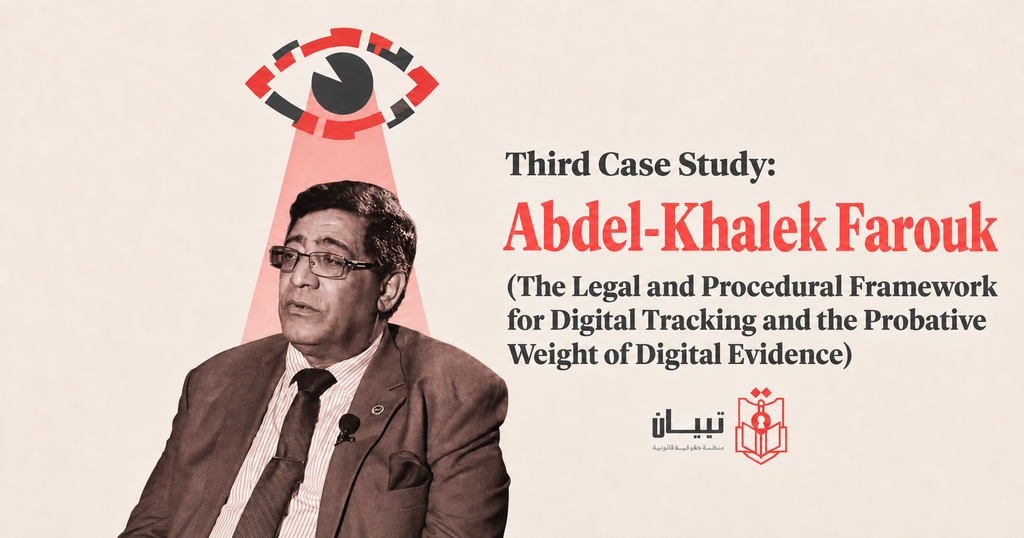
Case No. 4027 of 2025 (El-Shorouk Misdemeanors), registered as Case No. 4937 of 2024 (Supreme State Prosecution) and involving economic researcher Abdel-Khalek Farouk, raises critical legal and technical questions regarding how law enforcement handles specialized digital publishing. This case demonstrates how research-based opinion texts published online were transformed into material grounds for criminal prosecution. It also illustrates the sharp conflict between proactive digital tracking techniques and constitutional guarantees protecting freedom of expression and scientific research.[39]
Mechanisms of Digital Content Tracking
The procedural architecture of the case relied on digital monitoring targeting a personal Facebook account under the name Abdelkhalek Farouk. Police investigation reports reveal that law enforcement relied on open-source intelligence and tracked the digital footprint left by publicly available research activities.
The legal issue centers on how authorities characterized this technical tracking. Digital investigations focused on analytical economic content, including written posts like “The Administrative Capital as a Model of Deviated Priorities” and recorded videos like “Egypt is Politically and Economically Compromised.” Authorities treated these academic publications as acts capable of producing generalized, harmful material effects.
Investigations relied on a procedural interpretation that considered posting publicly on Facebook, without restricting visibility to followers, as satisfying the element of public dissemination. Prosecutors argued this established a criminal intent to broadcast false news under Articles 80(D/1) and 102 (Bis/1) of the Penal Code. This highlights a fundamental structural flaw: the failure to distinguish between public data dissemination and constitutionally protected academic debate.[40]
Technical Handling of Digital Evidence and Chain of Custody
Police arrested Farouk under a Public Prosecution warrant, seizing computers and USB flash drives. Forensic examinations extracted locally stored text files (.pdf and .word), including hard-copy drafts of unpublished books and studies, such as a manuscript titled “How Egypt Was Plundered.”
These actions raise serious legal questions regarding the digital chain of custody under Law No. 175 of 2018 on Combating Cyber and Information Crimes. The digital evidence introduced in court consisted merely of printed screenshots of the posts attached as fixed material documents.
This practice repeats a critical flaw: relying on printed images from the internet without conducting a full technical examination that traces and documents the digital chain of custody. Printed screenshots open the door to legal challenges regarding evidence sufficiency, as criminal convictions require absolute certainty free from hypothetical alteration or tampering.
Conflating Executive Discretion with Expert Testimony
Farouk was referred to a criminal trial based on novel evaluative standards for digital content. To establish the “falsity” of the economic figures published by the accused, investigative authorities relied on an official letter issued by the Cabinet’s Information and Decision Support Center (IDSC), which had contacted the Ministries of Finance and Investment to audit the data.[41]
This procedure introduces two major flaws affecting fair trial guarantees and defense rights:
Executive Bias of the Expert Body: The IDSC is an administrative body subordinate to the Executive Branch. This creates an obvious conflict of interest regarding the technical impartiality required of an expert witness in a criminal proceeding, especially when the dispute revolves around criticizing the economic policies of that same Executive Branch.
Exclusion of Independent Judicial Expertise: The court rejected repeated defense requests to appoint an independent three-member committee of registered experts from the Ministry of Justice or economics professors. This departs from settled Court of Cassation jurisprudence, which dictates that courts cannot decide complex technical matters (like sovereign budgets and international investment agreements) based solely on administrative reports without allowing the defense to challenge them through an impartial, independent expert body.
Virtual Publishing and Extended Causal Attribution
Investigators further supported their case by relying on concurrent, identical citizen complaints. The case file contained an influx of citizen complaints used to claim that Farouk’s economic writings caused tangible societal harm. Specifically, complaints alleged that verbal altercations broke out among citizens on public transportation as a direct consequence of reading his posts.
Creating this procedural link between an online post and a hypothetical physical argument constructs the causal nexus required to criminalize publication and justify arrest. Ultimately, this integrated system-combining proactive tracking, horizontal complaints, administrative reports, and rapid sentencing-entrenches a deep chilling effect across academic and research spheres, forcing analysts to adopt strict self-censorship out of fear that their work will be weaponized against them.[42]
Conclusion of the Case Study
The case of Abdel-Khaleq Farouk demonstrates how the legal system handles specialized research published online. The case reveals an increasing reliance on proactive tracking of public sources and the conversion of social media posts into material evidence without documenting the digital chain of custody.
It also underscores the improper conflation of executive reports with impartial judicial testimony, denying the defense an equal opportunity to contest disputed content. Finally, it shows how digital surveillance interacts with collective citizen complaints to chill academic freedom.
Fourth Case Study: Omneya Sweidan
(Digital Tracking Mechanisms and Virtual Evidence in Economic Courts)
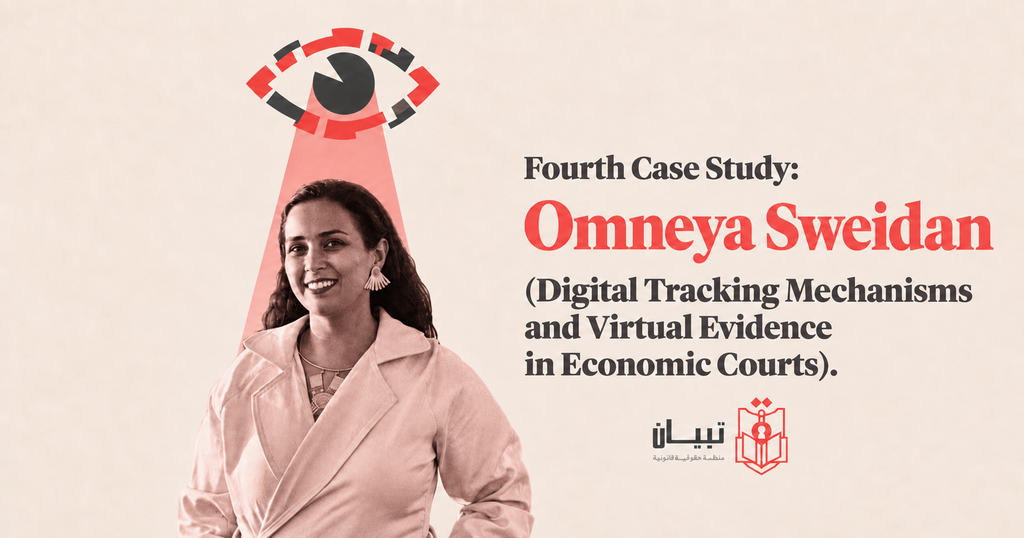
Case No. 457 of 2026 (Bab Sharq Economic Misdemeanors), registered as Case No. 94 of 2026 (Economic Crimes), illustrates how proactive digital tracking intersects with specialized prosecutions and economic courts in Egypt.
This case holds distinct academic weight due to the professional background of the accused, a former medical intern at Alexandria University Hospitals, and the nature of the disputed content. Sweidan’s expression of a professional opinion regarding public services was transformed into criminal material under newly enacted digital legislation.[43]
Complaint Architecture and Public Source Tracking
Proceedings against Sweidan originated from a formal complaint submitted by the legal representative of Alexandria University Hospitals to the Information Technology Department at the Alexandria Security Directorate. The complaint targeted a written Arabic post on a personal Facebook account under the name “Omneya Sweidan.” Arrest reports show that technical monitoring units relied entirely on reviewing account identifiers and web links (URLs) to attribute the account to the accused.[44]
The primary legal issue centers on how authorities characterized her online writing. Digital tracking targeted a detailed post criticizing crisis management, administrative failures, and the poor treatment of female medical interns and patients in the Obstetrics and Gynecology Department at El-Shatby University Hospital. The post contained sharp phrasing, describing El-Shatby Hospital as an “infested facility” and detailing administrative neglect.
Procedurally, the Public Prosecution relied on the technical tracking report as evidence satisfying “virtual publicity.” Prosecutors assumed that because the account was public, this created a legal presumption of criminal intent (mens rea) to broadcast news on the widest possible scale. This stretches the legal definition of publicity in virtual spaces compared to traditional physical environments.
Digital Defamation vs. Professional Criticism
The Alexandria Economic Affairs Prosecution referred the case to trial as a misdemeanor, charging Sweidan with intentionally broadcasting false news capable of disturbing public peace, instilling terror, establishing an account to commit a crime, and electronically defaming state public utilities. This characterization creates two core legal conflicts:
- Intent vs. Public Interest: Sweidan’s post detailed her practical experiences during her mandatory internship. In legal doctrine, recounting firsthand professional experience removes the text from bad-faith defamation and places it within legitimate criticism aimed at rectifying administrative deficiencies. Permissible criticism of public service facilities is protected when conducted in the public interest.[45]
- Procedural Overreach: Applying heavy charges like “disturbing public peace and instilling terror” to an internal critique of medical training mechanisms demonstrates the dangerous elasticity of digital enforcement laws. In practice, authorities escalated a routine administrative or syndical dispute into a criminal economic case.
Procedural Acceleration and Chilling Effects
The case moved with notable speed: the IT Department examined the complaint, interrogated the accused, and issued an expedited referral to the Economic Misdemeanors Court in an exceptionally short timeframe.[46] This haste reflects an institutional effort to deter online criticism of official service sectors, fostering self-censorship among professionals who fear digital prosecution.[47]
Dr. Sweidan’s case highlights systemic flaws in how state bodies handle professional opinions shared online. Monitoring was confined to superficial URLs without examining whether discussions occurred within closed professional contexts. This rapid procedural escalation deepens the chilling effect, forcing healthcare workers and public service providers into silence.
Conclusion of the Report
The rapid evolution of digital surveillance and criminal law enforcement in cyberspace has created a hostile legal reality. Considerations of public order and institutional reputation routinely override foundational constitutional guarantees protecting freedom of expression, scientific research, and professional critique.
Across all examined case studies, state authorities consistently expand the legal definition of critical digital content. Analytical writings, satirical art, economic research, and professional critiques are reclassified as threats to state security or digital economic crimes using elastic statutory terms like “disturbing public peace” and “broadcasting false news.”
Furthermore, forensic units suffer from a technical deficit. Law enforcement relies heavily on superficial URL tracking and printed screenshots as absolute proof of guilt, skipping the rigorous technical verification required to establish a digital chain of custody or rule out account spoofing and hacking.
Finally, this integrated surveillance framework enforces a widespread chilling effect. By weaponizing digital legislation against peaceful commentary, the state isolates public facilities from meaningful societal oversight and self-correcting critique.
Recommendations
To address these procedural and constitutional violations, the report proposes the following targeted recommendations:
1. Legislative Level
- Narrow Vague Criminalization Provisions: Amend the Penal Code and Law No. 175 of 2018on Combating Cyber and Information Crimes to strictly define elastic terms such as “disturbing public order,” “instilling terror,” and “insulting state institutions.” Criminal liability must require proof of direct, tangible, and severe material harm.
- Enact Whistleblower and Critic Protections: Pass explicit statutory protections for workers and professionals who report or critique deficiencies within public facilities (such as hospitals and universities), framing their commentary as protected public oversight rather than criminal defamation.
2. Judicial and Procedural Level
- Establish Strict Evidentiary Standards for Digital Proof: Require Criminal, Economic, and State Security Courts to strip printed digital screenshots of evidentiary weight unless substantiated by a comprehensive forensic analysis of server logs and IP records.
- Separate Executive Evaluation from Independent Forensic Expertise: Stop relying on administrative reports issued by executive bodies (such as the Cabinet’s Information and Decision Support Center (IDSC) or hospital legal departments) as expert evidence in criminal trials. Mandate the use of independent judicial expert committees to uphold the principle of equality of arms.
3. Technical Level
- Adopt International Protocols for Digital Investigations: Require IT departments within the Ministry of Interior to adhere to international standards for digital evidence collection (such as ISO/IEC 27037). Forensic units must document cryptographic hash values and analyze context rather than relying on raw URLs.
- Deploy Technical Verification to Rule Out Manipulation: Enhance forensic capabilities to scientifically distinguish between intentional account management and third-party spoofing, identity falsification, or unauthorized access before issuing arrest warrants.
[1] Foucault, Michel, Discipline and Punish: The Birth of the Prison, translated by Ali Moqalled, National Development Center, Beirut, Chapter 3 (“Panopticism”), pp. 218–240.
[2] Schmitt, Carl, Political Theology: Four Chapters on the Concept of Sovereignty, translated by Roger El-Khoury, Dar Al-Nahar, Beirut, Chapter 1 (“Definition of Sovereignty”), pp. 17–27.
[3] Fahmy, Khaled, All the Pasha’s Men: Mehmed Ali, His Army and the Making of Modern Egypt, Dar El-Shorouk, Cairo, Chapter 6 (“Discipline”), pp. 285–328.
[4] Arab Republic of Egypt, Telecommunications Regulation Law No. 10 of 2003.
[5] Arab Republic of Egypt, Anti-Cybercrime Law No. 175 of 2018 (Law on Anti-Cyber and Information Technology Crimes).
[6] Arab Republic of Egypt, Anti-Terrorism Law No. 94 of 2015.
[7] Arab Republic of Egypt, Decree Law No. 96 of 1952 Regulating Expert Work Before Judicial Authorities.
[8] Arab Republic of Egypt, The Constitution of the Arab Republic of Egypt of 2014 (as amended).
[9] United Nations, International Covenant on Civil and Political Rights (1966), Articles 17 and 19.
[10] Association for Freedom of Thought and Expression (AFTE), Human Rights Report: “Sieged Spaces: Censorship and Security Prosecution of Digital Content in Egypt”, Cairo, pp. 12–25.
[11] Arab Republic of Egypt, Law No. 180 of 2018 Regulating Press, Media, and the Supreme Council for Media Regulation, Official Gazette, Issue No. 35 bis (b).
[12] Al-Manassa and Mada Masr, Joint Investigative Reports: “Between Administrative Blocking and Judicial Prosecution: How Media Censorship is Managed in Egypt”, October–November 2023.
[13]Association for Freedom of Thought and Expression (AFTE) et al., Joint Statement: “28 Civil Society Organizations Condemn the Continued Blocking of Al-Manassa and Call on Egyptian Authorities to Unblock Dozens of News Websites”, August 2, 2022.
[14] Saheeh Masr, Official Statement by the Editorial Team: “Regarding the Supreme Council for Media Regulation’s Summons Concerning Information Reports”, Published July 2023.
[15] Arab Republic of Egypt, Prosecutor General’s Decision No. 565 of 2020 Establishing the Monitoring and Analysis Unit within the Prosecutor General’s Office.
[16] Egyptian Public Prosecution, Statement by the Public Prosecutor’s Office Regarding Case No. 22 of 2020 (Major Prosecution) [“TikTok Girls” Cases], May 2020.
[17] Arab Republic of Egypt, Law No. 10 of 2003 Regulating Telecommunications, Official Gazette, Issue No. 10 bis.
[18] Arab Republic of Egypt, Law No. 175 of 2018 on Anti-Cyber and Information Technology Crimes, Official Gazette, Issue No. 32 bis (a).
[19] Arab Republic of Egypt, Law No. 94 of 2015 on Anti-Terrorism, Official Gazette, Issue No. 33 bis (b).
[20] Arab Republic of Egypt, Decree-Law No. 96 of 1952 Regulating Judicial Expertise Work Before Judicial Authorities (as amended).
[21] Masaar – Technology and Law Community, Research Paper: *”The Legislative Impact of Non-Application of Electronic Evidence Controls”*, Masaar Website, accessed June 2026, available at: [https://masaar.net/ar/الأثر-التشريعي-لعدم-تطبيق-ضوابط-الدلي/](https://masaar.net/ar/الأثر-التشريعي-لعدم-تطبيق-ضوابط-الدلي/).
[22] Arab Republic of Egypt, Executive Regulations of Law No. 175 of 2018 on Anti-Cyber and Information Technology Crimes.
[23] Arab Republic of Egypt, Article 135 of Law No. 25 of 1968 (Law of Evidence).
[24] Arab Republic of Egypt, Articles 30 and 41 of Law No. 150 of 1950 (Criminal Procedure Code, as amended), Amiri Press.
[25] Egyptian Public Prosecution, Case No. 662 of 2021 (Qasr El-Nil Misdemeanors) [Involving Director Mo’men Hassan on Charges of Promoting the Commission of a Terrorist Act via the International Information Network].
[26] Egyptian Court of Cassation, Criminal Division, Appeal No. 882 of Judicial Year 81, Session of September 21, 2011 (Establishing the rule that flagrante delicto attaches to the crime rather than the person of the suspect, and the nullity of ungrounded stop-and-frisk).
[27] Egyptian Court of Cassation, Criminal Division, Appeal No. 19285 of Judicial Year 86, Session of November 5, 2018 (Ruling on the nullity of searching mobile phones and individuals’ digital storage units without prior judicial authorization).
[28] Arab Republic of Egypt, Article 57 of the Constitution of the Arab Republic of Egypt of 2014 (as amended), Official Gazette, Issue No. 3 bis (a), issued on January 18, 2014.
[29] Arab Republic of Egypt, Article 30 of the Criminal Procedure Code, op. cit.
[30] Egyptian Court of Cassation, Criminal Division, Appeal No. 4520 of Judicial Year 83, Session of 12 March 2014 (Establishing the conditions for lawful stop-and-frisk and the invalidity of fabricated flagrante delicto).
[31] Arab Republic of Egypt, Articles 2, 3, and 4 of Law No. 151 of 2020 Enacting the Personal Data Protection Law, Official Gazette, Issue No. 28 bis (e), issued on 15 July 2020.
[32] Egyptian Court of Cassation, Criminal Division, Appeal No. 11322 of Judicial Year 87, Session of 16 March 2019, Collection of Court of Cassation Rulings, Technical Bureau, Vol. 70.
[33] On the theoretical concept of “proactive surveillance” as a tool for engineering the cyber public sphere and the expansion of digital authoritarianism, see: Jones, M. O. (2022). Digital Authoritarianism in the Middle East: Deception, Disinformation and Social Media. Oxford University Press.
[34] To demonstrate how digital surveillance is employed as a tool to control the electronic public sphere and restrict freedom of expression within the framework of growing digital authoritarianism, see: Diamond, L. (2019). The Road to Digital Unfreedom: The Threat of Postmodern Totalitarianism. Journal of Democracy, 30(1), 20–24.
[35] On the requirements for the integrity of digital evidence and the chain of custody when handling electronic evidence, see: Casey, E. (2011). Digital Evidence and Computer Crime: Forensic Science, Computers, and the Internet (3rd ed.). Academic Press.
[36] On the protection of digital privacy and the controls imposed by international human rights law on the search of electronic devices and access to digital data stored on them, see: United Nations Human Rights Council. (2014). The Right to Privacy in the Digital Age: Report of the Office of the United Nations High Commissioner for Human Rights (A/HRC/27/37).
[37] Regarding virtual assets, the Financial Action Task Force (FATF) defines the concept of “Virtual Assets” and establishes a regulatory framework to combat associated money laundering and terrorist financing, distinguishing them from digital data or content that does not inherently represent financial assets or stores of economic value; see: Financial Action Task Force. (2021). Updated Guidance for a Risk-Based Approach to Virtual Assets and Virtual Asset Service Providers.
[38] On the academic grounding of the concept of the “chilling effect,” and how digital surveillance-or the perception of its presence-can drive individuals toward self-censorship and curtail their participation in public discourse, see: Penney, J. W. (2016). Chilling Effects: Online Surveillance and Wikipedia Use. Berkeley Technology Law Journal, 31(1), 117–182.
[39] .paragraphs 21–25 regarding the applicability of the protection of freedom of opinion and expression to digital communication media, and the international conditions that must be met when imposing any legal restrictions on online expression; see: United Nations Human Rights Committee. (2011). General Comment No. 34: Article 19: Freedoms of Opinion and Expression (CCPR/C/GC/34).
[40] On the constitutional protection of the freedom of scientific research and the right to debate public policies, see: Articles 23 (guaranteeing freedom of scientific research) and 65 (freedom of thought and opinion) of the Constitution of the Arab Republic of Egypt of 2014 (as amended).
[41] Egyptian law and its executive regulations require adherence to technical standards that ensure the integrity and authenticity of digital evidence and the ability to verify that it has not been tampered with. These standards correspond in essence to what is known in digital forensic science as the concept of the “digital chain of custody,” as detailed by Casey in his reference work.
[42] On the theoretical grounding of the concept of the “chilling effect,” and how the threat of legal prosecution or vague laws can drive individuals toward self-censorship and refrain from exercising freedom of expression, see: Schauer, F. (1978). Fear, Risk and the First Amendment: Unraveling the “Chilling Effect”. Boston University Law Review, 58(5), 685–732.
[43] On the standards for online freedom of expression and the prohibition of overly broad cyber-criminalisation, see: Article 19 of the Universal Declaration of Human Rights (concerning freedom of opinion and expression and the dissemination of information across borders).
[44]On international standards governing the identification, collection, acquisition, and preservation of digital evidence to ensure its integrity and verifiability of authenticity, see: ISO/IEC 27037:2012 Guidelines for Identification, Collection, Acquisition and Preservation of Digital Evidence.
[45] Al-Najjar, Imad Abd al-Hamid. (1977). Permissible Criticism: A Comparative Study [Al-Naqd al-mubah: dirasah muqaranah]. Cairo: Dar al-Nahda al-Arabiyya.
[46] Expediting the referral of the accused to trial—if it results in depriving them of adequate time or facilities to prepare their defence—may raise a concern under the fair trial guarantees set forth in Article 14(3)(b) of the International Covenant on Civil and Political Rights.
[47] See Note 45