
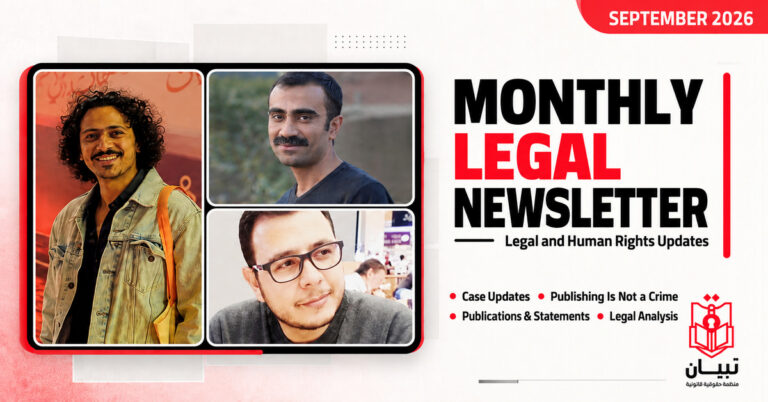
In its monthly newsletter, Tbian for Rights and Freedoms documents legal and human rights developments between 1 and 30 September 2026. This issue covers pretrial detention renewals and trial adjournments in cases followed by the team, the continued issuance of decisions affecting defendants’ liberty despite their absence from detention review hearings, and calls for medical care for detainees.
The newsletter also reviews the “Publishing Is Not a Crime” campaign, Tbian’s publication on the securitization of satirical expression in the case of “Qaa Al-Hamour,” its condemnation of the arrest of the Matsda2sh editorial team, and its participation in calls for the release of photojournalist Hamdi El-Zaeem. It concludes with an analysis of the impact of prolonged detention and criminal proceedings on freedom of expression, and the safeguards needed to ensure that detention reviews protect liberty.
1. Legal Support
September saw further pretrial detention orders in cases involving social media posts, videos, artistic works, and expressions of solidarity, as well as trials adjourned to later hearings. The following entries bring together updates on 18 cases during the month, including the latest published decision in each.
1. Karim Ayman and Others — The “Watan Horr” Case
On 5 September, the First Circuit adjourned the trial to 1 November 2026 to allow the case documents to be reviewed and ordered the appointment of a social worker to assess the child defendants. The proceedings concern Case No. 3025 of 2026, Fifth Settlement Felonies, registered as Case No. 2808 of 2024, Supreme State Security Prosecution.
On 6 September, the Second Circuit adjourned the trial to 2 November 2026 for defense pleadings, at the defense’s request, in Case No. 19862 of 2024, First Settlement Felonies, registered as Case No. 93 of 2022, Supreme State Security Prosecution. The case relates to posts expressing solidarity on Facebook.
On 6 September, the researcher and journalist’s detention was renewed for 45 days in Case No. 2469 of 2025. The decision was issued in his absence after prison guards informed the court that he had refused to attend.
4. Thirty-Two Shia Citizens, Including Mohamed Haidar Qandil
The Supreme State Security Prosecution renewed their detention for 15 days at hearings on 6 and 7 September, and again on 20 and 21 September, in Case No. 5635 of 2026. Most defendants face charges of joining and financing a terrorist group, while journalist and photographer Mohamed Haidar Emad Youssef Qandil faces charges of leading and financing the group.
The Supreme State Security Prosecution renewed the physician’s detention for 15 days at hearings on 7 and 21 September in Case No. 3596 of 2026, which includes charges of spreading false news and using an online account. He was arrested at the airport on 14 August upon returning from Saudi Arabia and appeared before the prosecution the following day.
The Supreme State Security Prosecution renewed lawyer Mohamed Abu El-Diyar’s detention for 15 days at hearings on 13 and 27 September in Case No. 4502 of 2026. He was arrested on 25 May and is a member of the Committee for the Defense of Prisoners of Conscience.
7. Khaled Mohamed Ali Mokhaimer (“Logy”)
Mokhaimer’s detention was renewed for 15 days on 6 September, then for 45 days on 14 September at his first appearance before the Criminal Court, in Case No. 2846 of 2026. The case relates to videos in which he described being subjected to torture at Dekheila Police Station, according to his account.
Filmmaker Omar Salah’s detention was renewed for 15 days on 14 September, then for 45 days by the Second Circuit on 28 September, in Case No. 3835 of 2026. His defense continued to request consultations in vascular medicine, internal medicine, thyroid care, psychiatry, and physiotherapy, as well as follow-up care for ulcerations on his wrist and the provision of necessary treatment.
9. Khaled El-Shazly, Mostafa Nabih, and Others
On 14 September, the detention of Khaled Amr El-Shazly Abu El-Hassan El-Sayed, Mostafa Amin Nabih, and others was renewed for 45 days in Case No. 664 of 2026. The case concerns the song “Heya Fawda” by the band “Fekra” and includes charges of joining a terrorist group and spreading false news.
10. Mohamed Abdel Karim Mohamed Zahran
On 21 September, the Supreme State Security Prosecution renewed Zahran’s detention for 15 days in Case No. 5773 of 2026, with no new developments in the investigation. The case relates to a meeting to discuss the implementation of a court judgment concerning the Teachers’ Syndicate.
Hassan’s detention was renewed for 15 days on 21 September, then for 45 days on 27 September, in Case No. 4373 of 2026, which includes charges of spreading false news and using an online account to promote a terrorist offense. He was arrested on 22 May and appeared before the prosecution on 24 May.
On 27 September, the Second Terrorism Circuit of the Criminal Court renewed Sobhy’s detention for 45 days in Case No. 7143 of 2025, in connection with writings on Facebook. He was arrested on 22 October 2025.
13. Ayman Abdel Rahman Mohamed Afifi
On 27 September, the Second Terrorism Circuit of the Criminal Court renewed Afifi’s detention for 45 days in Case No. 7143 of 2025, in connection with Facebook posts. He was first questioned in the case on 11 October 2025.
14. Six Citizens Detained over a Banner Expressing Solidarity with Palestine
On 27 September, the detention of Omar Sami El-Ansari, Abdallah Ahmed Abdel Dayem, Shehab El-Din Ashraf, Youssef Yasser Mohamed Farran, Mohamed Ahmed Hamed Diab, and Shady Mohamed was renewed for 45 days in Case No. 1644 of 2024. They were arrested in Alexandria on 28 April 2024 after displaying a banner expressing solidarity with Palestine and opposition to the war.
On 28 September, Refaat’s detention was renewed for 45 days in Case No. 1382 of 2026. The decision was issued in his absence because a video link to his place of detention could not be established.
16. Mostafa Ahmed Ramadan Tawfik
On 28 September, Mostafa Ahmed’s detention was renewed for 45 days in Case No. 945 of 2026. The decision was issued in his absence after the prison reported that he was ill.
17. Mohamed Ahmed El-Sayed Allam (“Rivaldo”)
On 28 September, Rivaldo’s detention was renewed for 45 days in Case No. 9 of 2025, despite his absence because a connection to his place of detention could not be established. This was another instance in which he was unable to participate in his detention review hearing, following a similar incident on 24 August.
18. Hamdi El-Zaeem, Mohamed Saeed Fahmy, and Others
On 27 September, the court adjourned the trial to 11 October 2026 for prosecution pleadings, without examining the merits because some defendants were absent. The proceedings concern Case No. 29 of 2025, Fifth Settlement Felonies, registered as Case No. 2 of 2025, New Cairo General Register, and Case No. 955 of 2020, Supreme State Security Prosecution. The news report notes that Mohamed Saeed Fahmy has been detained since May 2018 and that two release orders were not implemented before he was charged again in successive cases.
2. Campaigns
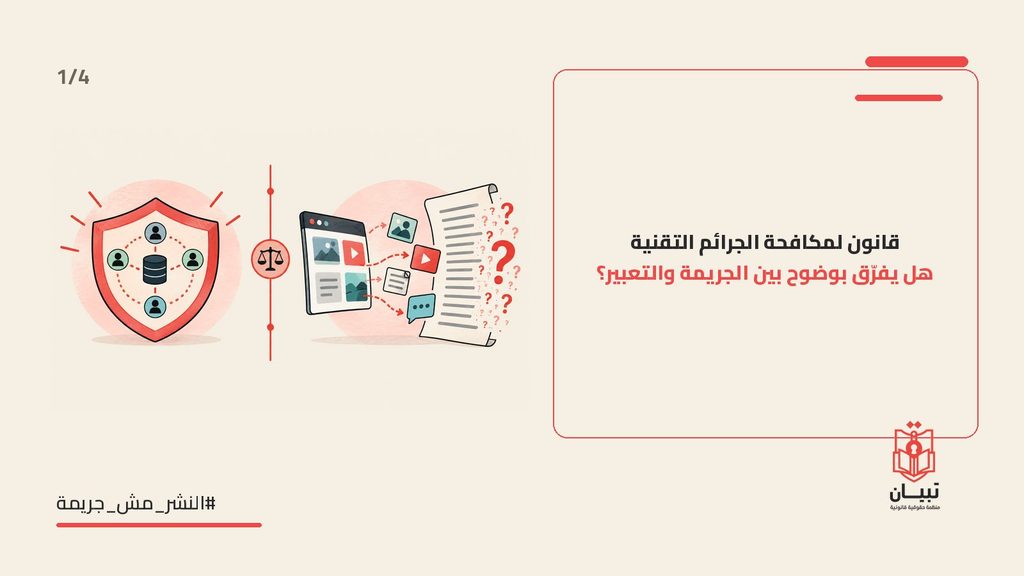
The “Publishing Is Not a Crime” Campaign
Tbian launched the “Publishing Is Not a Crime” campaign in September 2026 with an awareness-raising video followed by a series of campaign posts. The campaign addresses the impact of the Anti-Cyber and Information Technology Crimes Law No. 175 of 2018 on freedom of expression, journalism, and digital privacy, as well as the safeguards that should govern the handling of published content and users’ data.
The posts covered the scope of the law, terminology relating to “family values,” provisions governing the creation and management of accounts and websites, the retention of and access to users’ data, and website blocking. The campaign also linked the protection of digital journalism to a review of the legislation affecting its practice, looking beyond the Press and Media Regulation Law alone.
The campaign calls for precise legal definitions, an end to the use of detention against peaceful expression, effective judicial oversight of data access and website blocking, and the ability of defense lawyers to examine and challenge digital evidence. It stresses that combating hacking, fraud, and attacks on data must go hand in hand with protecting journalism, criticism, and users’ privacy.
Watch the campaign launch video
3. Statements and Joint Statements
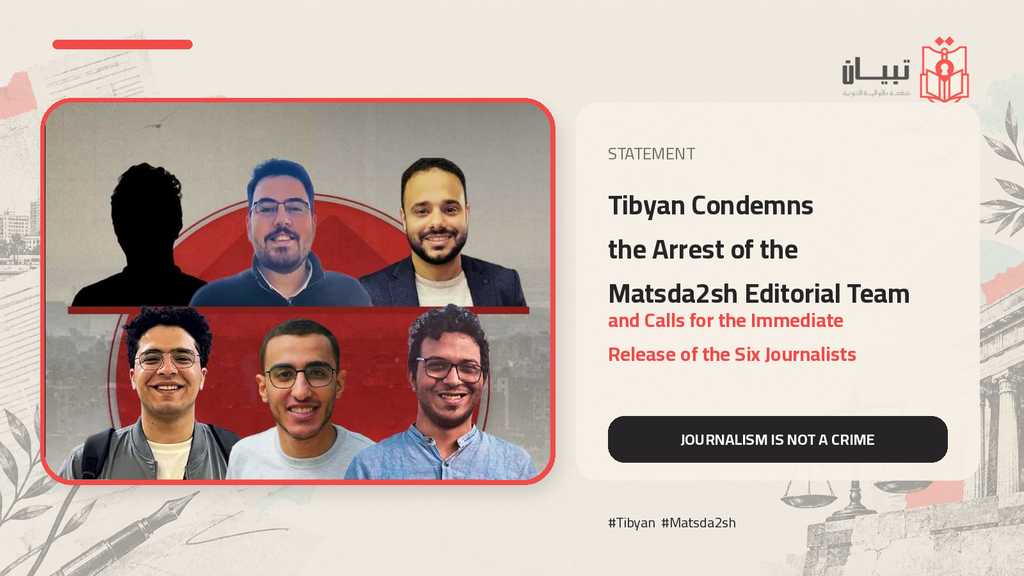
Condemning the Arrest of the Matsda2sh Editorial Team
Tbian published a statement on its platforms condemning the arrest of six journalists from the Matsda2sh editorial team: Mohamed Ashraf Abu Omeira, Abdallah Qadry, Islam Barakat, Mohamed Adel, Mohamed Mahmoud, and Omar Helal.
The statement stressed that the arrest of an entire editorial team, with their places of detention and the reasons for their arrest undisclosed, and without enabling them to contact their families and lawyers at the time of publication, constitutes a serious violation of press freedom and fundamental legal safeguards and threatens the public’s right to know and to access and share information.
Tbian held the Egyptian authorities responsible for the safety of the six journalists and called for the immediate disclosure of their places of detention, full respect for their legal rights, and their immediate and unconditional release. It affirmed that journalistic work must never be grounds for prosecution or detention.
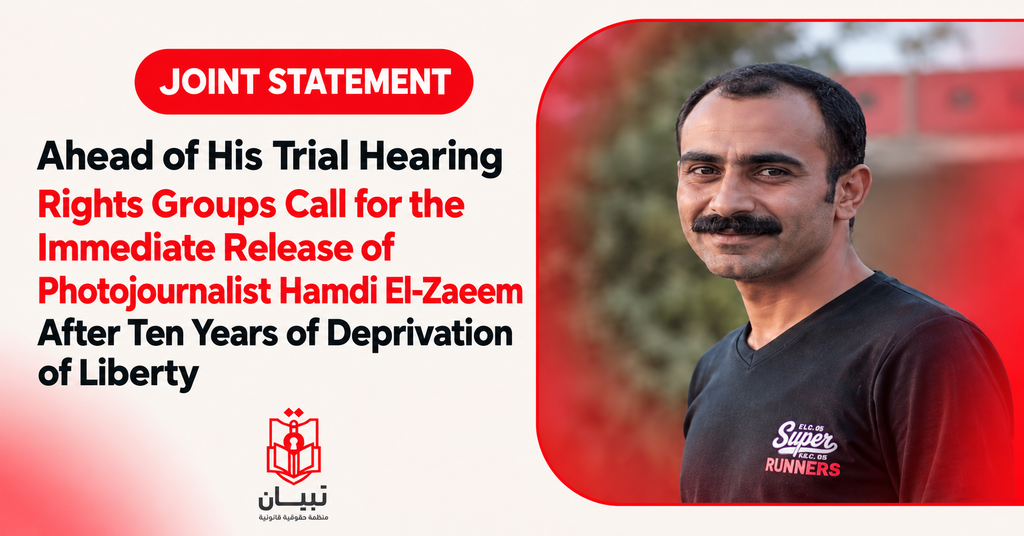
Calling for the Release of Photojournalist Hamdi El-Zaeem
Tbian joined a statement published on 26 September calling for the immediate release of photojournalist Hamdi Mokhtar Ali, known as Hamdi El-Zaeem, and an end to the proceedings and restrictions he has faced since 2016, encompassing pretrial detention, precautionary measures, and trial proceedings.
The statement emphasized the impact of these years on his professional and family life and health, and the need to end the use of temporary measures in ways that turn them into prolonged punishment before a final judgment. It also called for the release of journalists detained because of their work or their peaceful exercise of freedom of expression.
4. Publications
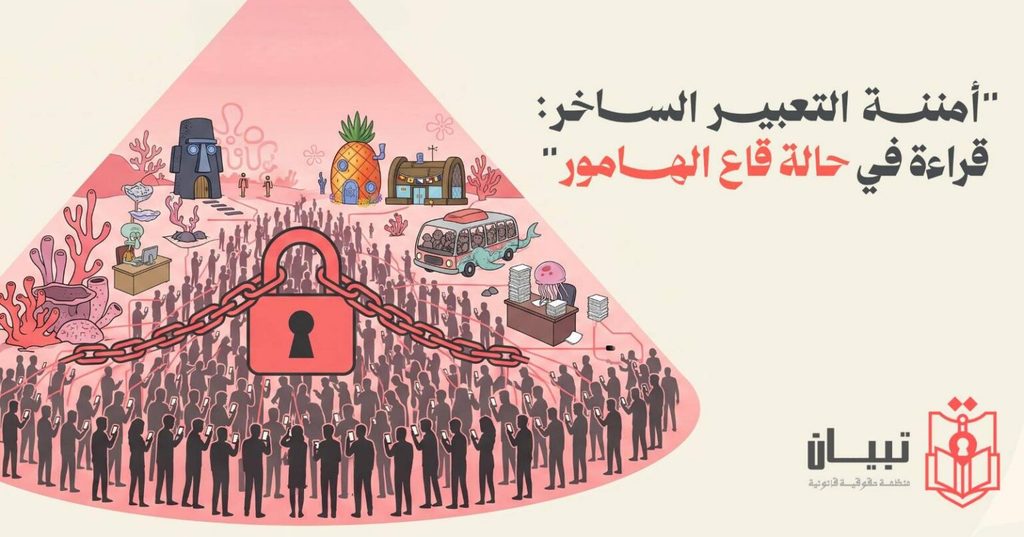
“The Securitization of Satirical Expression: A Reading of the Qaa Al-Hamour Case”
In September, Tbian published a paper on the “Qaa Al-Hamour” phenomenon, examining how participants used a cartoon world to express the pressures of everyday life before the online community became the subject of warnings, accusations, and legal complaints.
The paper explores how satire moved from a space for entertainment and collective expression to an object of security suspicion, placing the case alongside earlier instances of prosecution over humorous content. It also discusses how fear of legal repercussions can drive users to restrict their own expression, and the safeguards needed to distinguish legitimate expression from a threat that could justify necessary and proportionate intervention.
The analysis emphasizes that the size of a piece of content’s audience, or its ability to bring large numbers of users together, is not in itself sufficient to regard it as a security threat.
V. Monthly Analytical Brief
When Proceedings Become Punishment: Prolonged Detention and Its Impact on Freedom of Expression
September’s developments raise a question that goes beyond the duration of each detention order: how can we ensure that repeated renewals and trial adjournments do not become a de facto punishment imposed on defendants before the charges against them have been adjudicated?
In Hamdi El-Zaeem’s case, the joint statement documents ten years of detention, restrictive measures, and proceedings—not ten uninterrupted years in prison. In Mohamed Saeed Fahmy’s case, the trial update notes that he has been detained since May 2018 and that two release orders were not implemented before he was charged again in successive cases. Both cases demonstrate the importance of examining the entire course of restrictions on liberty and their impact on a person’s life, work, and family, rather than considering each measure in isolation.
Joint statement on Hamdi El-Zaeem | Trial update
Judicial Review Must Test the Need for Continued Detention
Article 9 of the International Covenant on Civil and Political Rights guarantees the right to trial within a reasonable time or release and provides that detention of people awaiting trial should not be the general rule. The Human Rights Committee’s General Comment No. 35 explains the need to reassess the grounds for detention periodically and consider available alternatives: an initial detention order does not remove the need to justify its subsequent continuation.
Such a review requires specific questions: what risk justifies this person’s continued detention? Does that risk still exist? Could it be addressed through a less restrictive measure? How do the passage of time, changes in the investigation, or the person’s health affect the need for detention?
These questions are especially important in cases involving published content. The description of the charge should not substitute for evidence and individualized reasons supporting continued detention.
Defendants’ Absence Undermines Their Ability to Defend Their Liberty
Detention renewal orders continued to be issued in September in the absence of the people concerned, for different reasons: a connection could not be established to the places of detention of Essam Refaat and Mohamed Allam; the prison reported that Mostafa Ahmed was ill; and the court was informed that Ismail El-Iskandarani had refused to attend. These different circumstances should not be treated as identical. They all, however, raise questions about defendants’ practical ability to participate in the review of their detention.
Essam Mohamed Refaat | Mohamed Ahmed El-Sayed Allam (“Rivaldo”) | Mostafa Ahmed Ramadan Tawfik | Ismail El-Iskandarani
General Comment No. 35 stresses the importance of detainees appearing before the court and having access to legal assistance so that the lawfulness of detention and their treatment can be examined. Accordingly, the reasons for absence should be verified and recorded, effective communication with defense counsel should be enabled, and barriers to participation should be addressed rather than becoming a recurring feature of detention renewal proceedings.
Medical Care Is Part of Protecting Detainees
Omar Salah Marei’s case illustrates the impact of continued detention alongside unmet medical needs, as reported by his defense. The issue extends beyond recording a request for medical examination in the hearing record: it requires following up on its implementation, ensuring access to treatment and the necessary specialists, and assessing the implications of the detainee’s health when considering continued detention.
Update on Omar Salah Marei’s case
In this analysis, we consider that effective judicial oversight must also be assessed by its ability to follow up on what happens after an order is issued: was the medical examination carried out? Did the defense receive the report? Was the detainee given an opportunity to explain any changes in their condition?
Protecting Expression Requires Safeguards in Law and Practice
These developments intersect with the question raised by the “Publishing Is Not a Crime” campaign: how can we prevent publishing and expression from becoming a gateway to punishment before judgment? Clear legislation remains essential, but it must be accompanied by judicial practice that examines evidence, tests the grounds for detention, and ensures the participation of defendants and their lawyers.
September’s monitoring highlights the need for serious, individualized reviews of continued detention, trials without unjustified delay, implementation of release orders, follow-up on medical care, and protection of the rights of the defense. The damage that years of proceedings inflict on liberty, work, and health does not disappear simply because a new hearing date is set.